Monday, April 8, 2024

Does Alice [Work] Here Anymore?

Determining whether computer-implemented technology is eligible for U.S. patent protection continues to be an endeavor subject to scholarly disputes and patent litigation.  For example, a dispute over patent eligibility of claims to a system and method for processing (transmitting and visualizing) three dimensional images from two dimensional images is the subject of a recent U.S. Federal Circuit decision.   AI Visualize, Inc. v. Nuance Communications, Inc.

Distilling the two competing arguments (for and against patentability) were (1) improved functionality of a computer vs (2) abstract idea without an inventive concept transforming the abstract idea to something more.

The Court found the claims were the later and not the former using the U.S. Supreme Court’s two step analysis of Alice Corp. v. CLS Bank Int'l :: 573 U.S. 208 (2014).  In a nutshell, the Court found the claims essentially directed to non-patent eligible data manipulation.

After you read the decision, see if you…

            (1) agree with the Fed. Cir. and find the claims are directed to an abstract idea and nothing more, or

            (2) disagree with the Fed. Cir. and believe the claims improve the function of a computer and therefore should be considered patent eligible.

Then, please opine if you find the two-step analysis works or if you find “Alice Does Not [Work] Here Anymore.”

I have some thoughts to improve a likelihood patent claims will satisfy the current Alice test for subject matter eligibility but would like to hear what others have to say before adding what I consider to be a successful strategy.

Also, comments on improvements of claim language that would be more likely to establish “something more” than data manipulation.

Continue on to the full OP-IP Law Blog

© Stephen J. Weyer 2024

(* Disclaimer: All views expressed are exclusively those of the authors and do not reflect the views of Stites & Harbison, PLLC)

Monday, August 21, 2023

"Paradise Lost" ... failed attempt to assert AI generated painting

 "Paradise Lost" 

... a failed attempt to assert copyright registration for AI generated painting 


In an attempt to assert copyright registration for an AI generated painting, facts matter.  Computer system ("Creativity Machine") owner ("plaintiff"), asserted in a U.S. copyright registration application that his computer system, generated the work, "A recent Entrance to Paradise," (shown here) on its own and without any human involvement.

The U.S. Copyright refused the registration on the grounds that it lacked authorship (i.e. a human author).   See THALER V. PERLMUTTER, 1:22-cv-01564, (D.D.C.).

The computer owner (plaintiff) appealed the Copyright Office's rejection to federal court.  In his appeal, he asserted new facts not in the copyright registration or before the Copyright Office, including that he..

  1. "provided instructions and directed his AI to create the Work",
  2. "the AI s entirely controlled by [him]", and 
  3. “the AI only operates at [his] direction.”

However, since these facts were not asserted in the copyright application, the court rejected their consideration in its decision.  As a result the court agreed with the U.S. Copyright Office's refusal to grant copyright registration for the AI generated work. See THALER V. PERLMUTTER, 1:22-cv-01564, (D.D.C.).

Some commentators hail this copyright ruling as a victory for authors, artists, actors, and the like, over AI generated content for "would be" copyrightable works.  The thinking is that if AI generated content is not copyrightable, then the AI generated content could be copied.  And, without copyright protection, studios, publishers, television networks, etc., would be less likely to replace writers and actors with AI generated content.

Well, not so fast.... While this case underscores the principle that for U.S. copyright registration, the work must be the authorship of humans, the court did not dismiss the notion that AI generated content, that was directed to be produced by a human and controlled by a human could be subject to copyright registration. 


Continue on to the full OP-IP Law Blog

© Stephen J. Weyer 2023

(* Disclaimer: All views expressed are exclusively those of the authors and do not reflect the views of Stites & Harbison, PLLC)


Tuesday, November 22, 2022

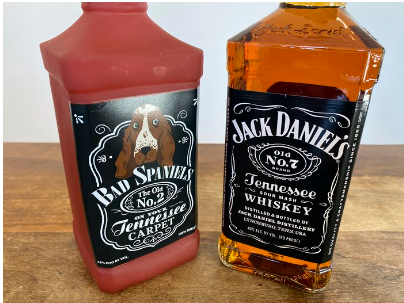
"Bad Spaniels Silly Squeaker" Dog toy....Trademark infringement or is Jack Daniel's barking up the wrong tree ?

(AP Photo/Jessica Gresko)
Does the dog toy, "Bad Spaniels Silly Squeaker" (left) infringe Jack Daniel's trademark (see its bottle, right)?

Jack Daniel's says YES.

"VIP" (manufacturer of the Bad Spaniels toy) says NO.

The ninth Circuit Court of Appeals says NO.

Now the U.S. Supreme Court will review the trademark dispute with a hope that it will provide clarity of what is and is not trademark infringement under U.S. federal trademark law when one endeavors to incorporate elements in its product that reassemble another's trademark.

The specific legal issues and legal procedure at the heart of this trademark dispute that the U.S. Supreme Court will likely address are surely interesting to trademark attorneys, legal scholars, law professors, and law students to name a few. 

But, since OP-IP is directed to the general business community and not what my Constitutional Law professor referred to as the "egg heads," a more interesting topic for consideration here is whether the arguable parody of the Jack Daniel's bottle (marks) (Bad Spaniel's toy) should be permissible or whether the Bad Spaniel's toy should be considered a trademark infringement.  

The talking heads on both sides of the debate have weighed in for and against trademark infringement.

What do you say....

Continue on to the full OP-IP Law Blog

© Stephen J. Weyer 2022

Learn more

(* Disclaimer: All views expressed are exclusively those of the authors and do not reflect the views of Stites & Harbison, PLLC)
Send email feedback-  Stephen Weyer's email account ('OP_IP')